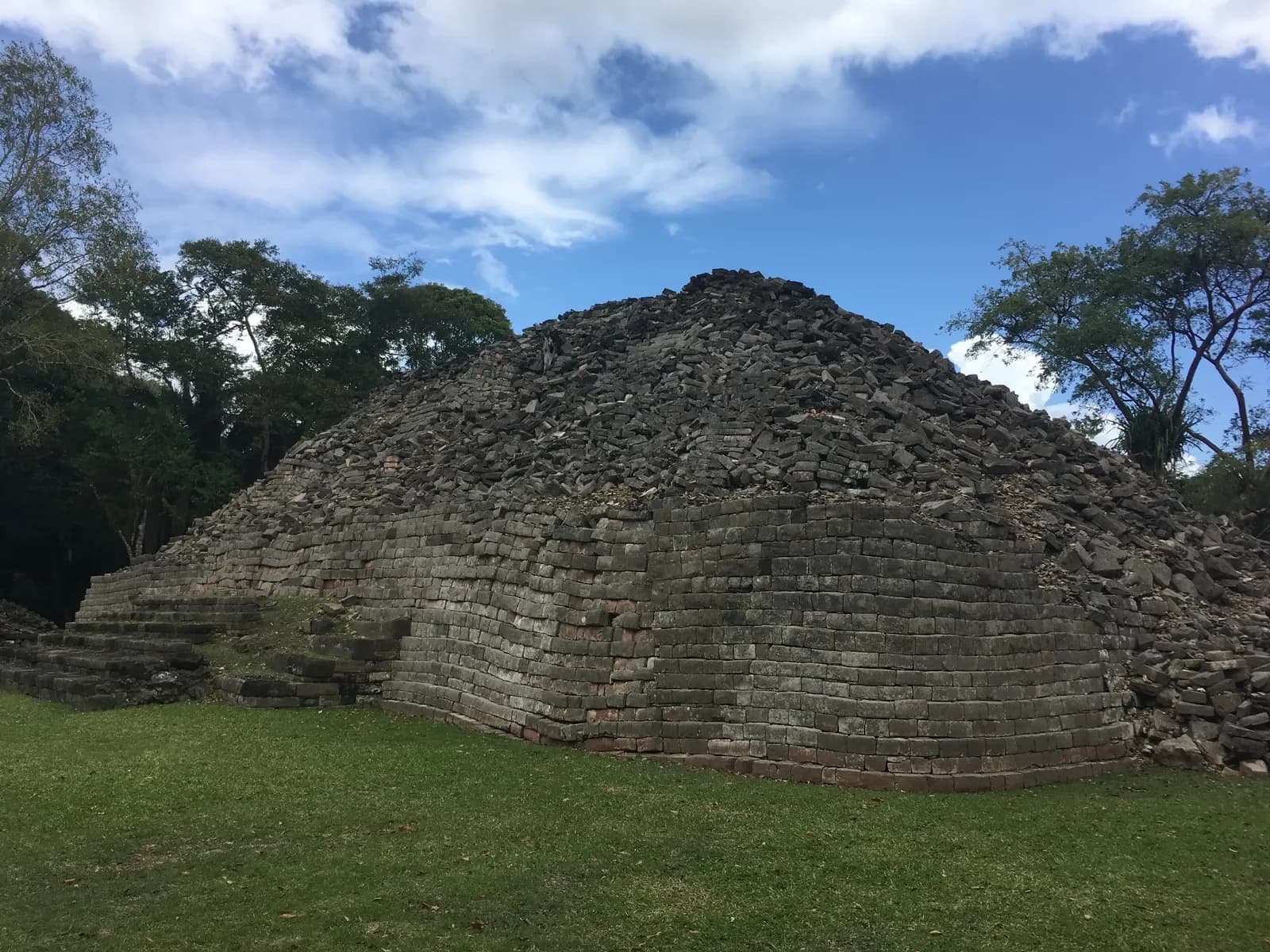
Lubaantun does not look or feel like Belize's other major Maya sites. There is no El Castillo, no towering Caana. Instead you move between terraces, stairways, plazas, ballcourts, and piles of carefully cut stone, with the forest growing around everything. The name, "Place of Fallen Stones" in Mopan Maya, fits perfectly.
The first thing I notice is the stonework. Much of the monumental architecture was built from shaped blocks fitted together without mortar, which gives the ruins their distinctive look and explains why so many stones have shifted and fallen over the centuries. I actually like that Lubaantun has not been reconstructed to perfection. Some buildings are clearly legible; others are enormous mounds of stone disappearing under trees, and it makes you think about what happens to a city after centuries of rain, roots, and forest.
Norman Hammond's excavations placed most of the city's development in roughly AD 730–860, so the center you visit rose and declined within a few generations. The Maya ballgame clearly mattered here: three major ballcourts, carved ballcourt markers, and large numbers of mould-made ceramic figurines and whistles, some dressed as ballplayers. And then there is the Crystal Skull. Lubaantun is famous as the supposed discovery site of the Mitchell-Hedges skull, but Smithsonian research showed it was carved with modern rotary tools, and records show it was bought at a Sotheby's auction in 1943. Knowing that makes the visit more interesting, not less: real archaeology on one side, a famous legend on the other.
One of Belize's most unusual architectural styles. Fitted stone blocks laid without mortar give the site a look no other major center has.
A city where the ballgame mattered. Three ballcourts, carved markers, and figurines of ballplayers.
The truth behind the Crystal Skull. Stand where the legend attached itself and separate the story from the archaeology.
Planning your visit: Near San Pedro Columbia, Toledo District. Allow 1–2 hours. Bring drinking water, sun protection, insect repellent, and shoes with grip for uneven stone paths.
Confirm current opening hours, admission and access conditions with Belize's Institute of Archaeology before travelling. Transport and guiding are separate from site admission.
Official site information: https://nichbelize.org/ia-sites/lubaantun/