On Good Friday in Benque Viejo del Carmen, a quiet border town 81 miles west of Belize City, residents begin painting their streets while the rest of the country sleeps.
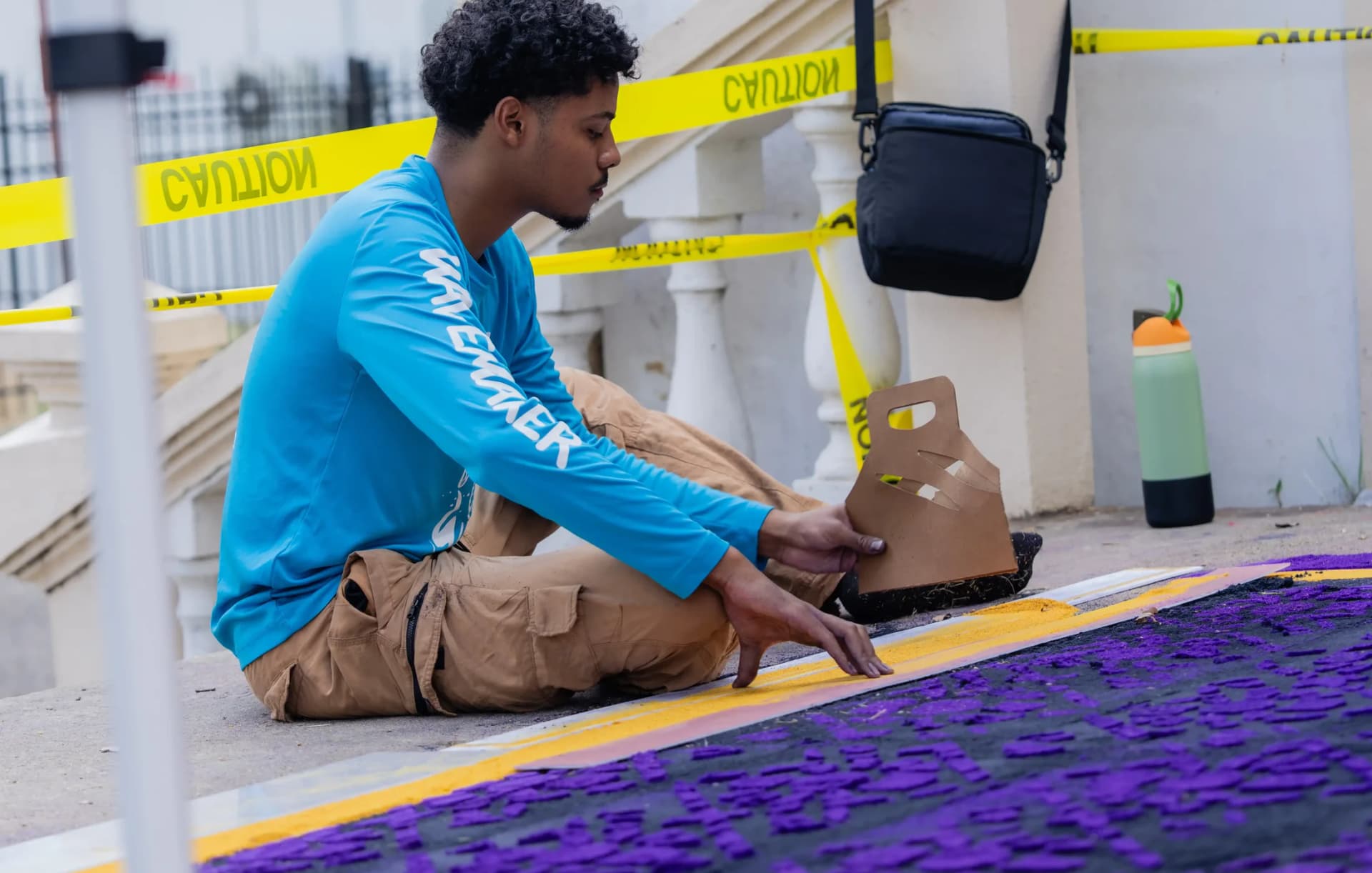
Starting as early as 1:00 in the morning, families and community groups kneel on the pavement and layer vibrant, hand-dyed sawdust into elaborate patterns using wooden and cardboard stencils. They add flowers, leaves, pine needles, and different seeds, along with rice and other natural materials. They water the finished sections to hold them against the wind. They work until the sun comes up, and then keep going.
By the time the afternoon procession begins, Benque's main streets look like something between an open-air gallery and a cathedral floor. Then forty men walk over all of it. On purpose.
This is the tradition of Alfombras de Aserrín: Good Friday sawdust carpets in Benque Viejo del Carmen, and it is one of the most visually stunning, culturally layered experiences in Belize. Most of the country has never seen it.

What You'll Find in This Guide
- Where is Benque Viejo del Carmen?
- The Cultural Roots: Why Benque Does Easter Differently
- Founding Legacy: Mrs. Josefina Salas, Tía Fina
- The Alfombras: How the Sawdust Carpets Are Made
- The Procession: El Santo Entierro
- Full Day Timeline
- Local Tips: The Cayo Insider Angle
- FAQ
- What's Next: Holy Saturday in San Ignacio
Where Is Benque Viejo del Carmen?
Benque Viejo sits at the westernmost edge of Belize, pressed right against the Guatemalan border in the Cayo District. It's approximately 81 miles from Belize City and less than a 20-minute drive from San Ignacio town, making it one of the easiest day trips in western Belize.
Getting there from San Ignacio:
- Taxi: The go-to option for most locals. A shared taxi from San Ignacio to Benque runs around $5 BZD. You can arrange one from your hotel or flag one down near the market in San Ignacio. No AC, no frills, but it's under 20 minutes and hard to beat on price.
- Bus: The Belize National Bus Company runs routes to Benque for $2.50 to $3 BZD. You can catch a bus from the main terminal in San Ignacio. Useful link for bus schedules: https://belizebusschedules.com
Bus schedule note: you can check the National Bus Company Ltd Facebook page for the latest schedule, and always verify times locally before making plans around the procession.
On any other day, Benque is calm and unhurried. Good Friday is the one day a year when that completely changes
The Cultural Roots: Why Benque Does Easter Differently
To understand Good Friday in Benque, you need to understand the town itself.
Benque Viejo is a Spanish-speaking, majority-Mestizo community with deep roots in Catholic tradition. Its cultural identity has been shaped by its location on the Guatemalan border, where processional heritage, Maya ancestry, and colonial Catholic practice have woven together over generations, as they have throughout Central America.
The alfombra tradition is syncretic in its bones. Its European chapter traces to the Canary Islands, specifically the municipality of La Orotava in Tenerife, where Spanish colonizers brought Catholic processional customs, including the practice of carpeting streets with flowers and natural materials before a liturgical procession passed. Those traditions traveled into the Americas with colonization and landed in communities across Guatemala, Mexico, Honduras, and Peru.
But what took root in Central America was not purely Spanish. Indigenous traditions of ceremonial offerings, communal ritual, and the spiritual significance of natural materials were already embedded in these communities. The Andean cross, the Chakana; the Maya fire ceremony and its offerings to the earth, these traditions share with the alfombra a fundamental grammar: that human beings mark what is sacred through making, and that the most powerful offering is one that is given fully, without being kept.
Three feelings run through every alfombra, regardless of the culture that shaped it: gratitude, offering, and redemption. And the most powerful symbol of the tradition is its ephemeral nature. Within hours of completion, the carpets are walked over by solemn processions carrying heavy religious floats, symbolizing humility, sacrifice, and the transient nature of life.
In Benque — a Mestizo town shaped by both colonial Catholic devotion and generations of cross-border exchange with Guatemala — the alfombras became something distinctly their own. The use of aserrín (sawdust), dyed and layered into elaborate patterns using community-made stencils, reflects that hybridized inheritance: ceremonial in its intent, communal in its labor, and rooted in the particular landscape and people of western Belize.
In Benque, the anchor of that tradition is Our Lady of Mount Carmel Catholic Church, whose parish was founded in 1905. The Diocese of Belize City and Belmopan formally recognizes it as being known for "the famous Holy Week procession and dramatized Passion on Good Friday."
According to Channel 5 Belize's 2014 coverage, the Santo Entierro procession dates back to the 1980s. The dramatized Passion reenactment has been running since approximately 1992. In 2008, organizers made a deliberate decision to pass leadership to the younger generation, recognizing that living traditions die without intentional transfer. Contemporary reporting from 2026 continues to highlight youth participation as the backbone of the event.
The National Institute of Culture and History (NICH) has formalized this recognition, naming the Benque Sawdust Tapestries Project as a signature initiative of the Benque House of Culture.
What makes Benque's version distinctive is how it layers devotional art, community labor, Passion drama, and solemn procession into a single day. It isn't one event. It's an entire liturgical sequence compressed into 24 hours.
And it was never designed for visitors. "It was never meant to become an attraction," one organizer told Channel 5. "That's what it has evolved into."
Founding Legacy: Mrs. Josefina Salas, Tía Fina
No account of the Benque Sawdust Tapestries is complete without honoring the woman who began it all.
Mrs. Josefina Salas known throughout the community as Tía Fina, was the founder of the Benque Sawdust Tapestries. She was a true visionary: an artist, a community anchor, and a patriot whose love for Belize ran through everything she made, from the elaborate alfombras that now define Good Friday in Benque, to the Belizean flags she crafted by hand for national celebrations.
Tía Fina was also the Madrina of the Benque Marimba LHDW and played a pivotal role in obtaining the marimba instrument for the community — ensuring that Benque's musical heritage, like its processional heritage, would endure. She celebrated the legacy of George Price with unwavering pride, and her commitment to preserving and sharing Belizean culture shaped the town's identity in ways that outlast any single event.
The tradition you witness on the streets of Benque on Good Friday, the families working before dawn, the stencils laid on cold pavement, the carpets given over to be destroyed, carries her name and her spirit in it.
We at Belize Travel Insider extend our heartfelt condolences to her family. Tía Fina's artistry and dedication live on in every alfombra laid in her wake. May her soul rest in eternal peace.

The Alfombras: How the Sawdust Carpets Are Made
The Alfombras de Aserrín are the visual heart of the day.
Preparing the Sawdust
Preparation begins weeks before Easter. Community teams gather sawdust from lumber yards , raw aserrín in its natural pale color. Then comes the dyeing.
The sawdust is first sieved to remove chunks and get a consistent texture, then dyed. Powdered dye is dissolved with alcohol, vinegar, and salt, which help the color absorb and fix into the wood fiber, before being mixed into the sawdust. Some makers also add a small amount of glue to help the finished carpet hold its shape against wind and foot traffic. Different batches are prepared for each color in the design — sometimes dozens of distinct hues, and bagged by color for distribution to participating groups. The dyed sawdust is then spread out to dry completely before use.
Some sections also incorporate sand, flowers, leaves, and different seeds that add texture, dimension, and natural variation to the finished carpet. Depending on the design, fine or coarse sawdust may be used — or a mix of both — for different effects.
Designing and Stenciling
Designs are planned at the neighborhood or family level in the weeks before Easter, sometimes with deliberate coordination so adjacent sections form a unified pattern across the street. Groups can work freehand or create their own stencils: a common method is to project a design onto cardboard, trace it, and cut it out with a craft knife. Commercially made stencils can also be purchased.
Essentially anyone can create an alfombra, provided arrangements are made in advance with organizers. Creativity is the only requirement, and that creative latitude is part of what makes each year's carpets different.
The Night of Making
Then, before sunrise on Good Friday, often starting at 1:00 in the morning, groups claim their sections of the main streets and begin.
The process unfolds in careful stages:
- Tents are set up over the work area for shade and wind protection.
- The pavement is wetted down so the sawdust grips the surface.
- Stencils are laid flat and the dyed sawdust is applied — sifted through strainers, poured from cones, or spooned from recycled cups, depending on the level of detail needed.
- Makers can work standing on the stencil, sitting on cardboard, reaching over a plank, or using extended DIY strainers to get the sawdust exactly where they need it.
- Stencils are lifted and repositioned as each section is completed.
- Natural materials — flowers, leaves, sand, seeds — are pressed into the surface by hand for texture and decoration.
- Volunteers spray or water the finished sections periodically throughout the night to keep the sawdust damp and hold designs together before the procession arrives hours later.
A single section can take up to ten hours to complete.
The finished carpets stretch along the town's main thoroughfares. Some panels depict traditional Passion imagery: Christ carrying the cross, the crucifixion, the burial. Others carry contemporary messages. The Belize Tourism Board describes them as serving "as a platform for artistic expression and cultural reflection." The street becomes simultaneously a catechism and a civic canvas.
Want to make your own? The SISE House of Culture of San Ignacio published a community guide to making sawdust tapestries — covering materials, dyeing, stenciling, and techniques. Download the Sawdust Tapestries Guide (PDF) — guide by Karla Pinelo / SISE House of Culture.


There is a theology built into the making. Every person who kneels on that pavement for ten hours is making a sacrifice: sleep, time, physical labor. One alfombra designer interviewed by Channel 5 described her participation as a promesa, a promise offered in gratitude for protection. The carpet is not meant to be preserved. It is meant to be given.
The Procession: El Santo Entierro
At 5:00 PM, the Holy Burial Procession, El Santo Entierro, begins to move through Benque's main streets.
This is the emotional climax of the day.
Young men, formally dressed in special vestments as members of the brotherhood of El Santo Entierro, carry the anda on their shoulders. The anda is a large ornate float built like a moving altar, presenting a dramatic biblical scene with a life-size figure of Jesus lying in a glass coffin, an angel, a Roman soldier, and a cross bearing the inscription INRI. Rich colors, candles, and symbolic detail make it one of the most striking religious floats you will see anywhere in Belize.

Other floats accompany it: the Virgin Mary, carried by women; Saint Joseph, carried by young men. A marching band provides the procession's soundtrack, somber and deliberately slow.
And the procession walks directly over the alfombras.
Each footstep erases hours of labor. This is not accidental. It is the entire point. The procession reenacts Christ's walk to Calvary, and the destruction of the carpets underfoot is part of that reenactment. Art made to be surrendered.
The procession covers the town's main streets and can take up to four and a half hours before arriving at Our Lady of Mount Carmel Church. By the time it ends, the streets that glowed with color since before dawn are swept clean.


Good Friday in Benque: Full Day Time
line
Time What's Happening
~1:00 AM. Community groups begin laying alfombras on the main streets
~9:00 AM Passion drama and Via Crucis (Stations of the Cross) begin
3:00 PM Church services begin, marking the hour of Christ's death
5:00 PM The Santo Entierro procession begins
~9:30 PM Procession arrives at Our Lady of Mount Carmel Church
Most shops in Benque will be closed for the full day. The town's solemnity is part of the atmosphere.
Good Friday in San Ignacio: Gallery
San Ignacio has marked Good Friday with a procession every year — a quieter, more intimate tradition than Benque's, but no less genuine. Since approximately 2023, the NICH San Ignacio House of Culture has introduced sawdust tapestry-making to the town, bringing the alfombra tradition across the district for the first time.
What makes the San Ignacio alfombras distinctive is how broadly the community turns out. Youth groups, schools, clubs, sports teams, businesses, and neighborhood organizations come together to claim their sections of the route. In 2026, participating groups included Sacred Heart Parish, the Kontiki Youth Group and Kontiki Neighborhood Watch, the Galen Anthropology Club, Sacred Heart Primary School, St. Ignatius High School, Sacred Heart College, the SISE Puede Girls, ASCON, VANTAGE, the SISE Town Council, and many more.


Local Tips: The Cayo Insider Angle
Wear sunscreen. If you're arriving in the morning to watch the alfombra-making process, you will be outside on open pavement in Belizean heat. Dress light, bring water, and protect your skin.
Check the town council Facebook page before you go. The Benque Viejo Town Council posts maps showing which streets are closed for the procession. Study this before you arrive so you know where to position yourself.
Arrive early if you want to watch the carpet-making. The most intimate and visually interesting part of the day happens in the early morning hours. If you can make the trip before sunrise, you'll witness the process that most people never see.
You can participate. This is not a spectator-only event. You are welcome to walk with the procession, follow the anda through the streets, and help carry sections of the altar if groups invite you. Ask locally when you arrive.
San Ignacio is also marking Holy Week. In 2023, San Ignacio and Santa Elena Towns collaborated on their first-ever Good Friday sawdust tapestries project. While San Ignacio does not currently hold a procession, the NICH San Ignacio House of Culture typically provides maps and Easter programming updates. Check their page as Holy Week approaches each year.
Base yourself in San Ignacio for the long weekend. San Ignacio is less than 20 minutes from Benque, making it the natural base for Easter weekend in Cayo. You can do Good Friday in Benque and Holy Saturday in San Ignacio back to back without changing accommodation.
Pair with Xunantunich on another day. The Maya ruins at Xunantunich sit just south of Benque Viejo, a short ferry crossing from the Western Highway. If you're already making the drive west, it's an easy add-on for the day before or after Good Friday.
Getting back: Taxis run between Benque and San Ignacio throughout the day. If you plan to take the bus back, confirm the last departure time before the procession starts. Holiday schedules can vary.
Frequently Asked Questions
What are the Alfombras de Aserrín in Belize? Alfombras de Aserrín are elaborate street tapestries made from dyed sawdust, flowers, leaves, seeds, flour, and other natural materials, laid along the procession route on Good Friday. In Benque Viejo del Carmen, they are created overnight by community groups and ceremonially destroyed when the Holy Burial Procession walks over them at 5:00 PM.
What time does the Good Friday procession start in Benque Viejo? The Santo Entierro (Holy Burial) Procession begins at approximately 5:00 PM and can last up to four and a half hours. Alfombra-making begins as early as 1:00 AM, and the Passion drama typically starts around 9:00 AM.
Can tourists and visitors participate in Good Friday in Benque? Yes. Visitors are welcome to watch the alfombra-making in the morning, walk with the procession in the evening, and attend church services. Be respectful of the religious nature of the day. Dress modestly, keep voices low during the procession, and follow the lead of those around you.
How do I get from San Ignacio to Benque Viejo for Good Friday? A shared taxi from San Ignacio to Benque costs approximately $5 BZD and takes under 20 minutes. Buses run for $2.50 to $3 BZD from the San Ignacio bus terminal. Confirm return times before the procession begins, as holiday schedules can vary.
Are shops and restaurants open in Benque on Good Friday? Most shops in Benque close for Good Friday. Plan ahead and eat before you go or bring food and water. In keeping with the Catholic tradition of abstinence, most Belizeans eat fish rather than meat on Good Friday, and you may find vendors selling fish dishes along the route.
When did the Good Friday tradition in Benque Viejo start? The Santo Entierro procession dates back to at least the 1980s. The dramatized Passion reenactment has been running since approximately 1992. The tradition was founded by Mrs. Josefina Salas (Tía Fina) and is rooted in Iberian Catholic processional culture carried through Central America. Benque's position on the Guatemalan border means it shares deep cultural ties with communities like Antigua, Guatemala, where similar traditions exist on a larger scale.
Who founded the Benque Sawdust Tapestries? The tradition was founded by Mrs. Josefina Salas, known as Tía Fina, a beloved community member, artist, and cultural leader from Benque Viejo del Carmen. She established the Alfombras de Aserrín as a living expression of Catholic devotion and Belizean identity. The National Institute of Culture and History (NICH) has since recognized the Benque Sawdust Tapestries Project as a formal cultural initiative through the Benque House of Culture.
What's Next: Holy Saturday in Cayo
Good Friday in Benque is just the beginning of Easter weekend in Cayo.
On Holy Saturday, San Ignacio comes alive in a completely different way with the cross-country cycling race, horse races, and the Easter Fair that draws crowds from across the district. If you're already in Cayo for Good Friday, staying through Saturday is an easy decision.
[Link to Holy Saturday in San Ignacio: coming soon.]
Useful Links
- Benque Viejo Town Council — procession route maps and street closures
- NICH San Ignacio House of Culture — San Ignacio Holy Week updates
- Travel Belize — Semana Santa in Benque Viejo — official tourism listing
Have you been to Good Friday in Benque? Share your experience in the comments below, or tag us in your photos.